The age of AI is undeniably here, and like many artists, I feel conflicted about its growing impact on the art world. I’m uncomfortable with the idea that AI models can be trained on the images I’ve shared online, learning from work that took me hours (or years) to create. And I recognise that AI is likely to swallow up a significant amount of commercial creative work, making it even harder for artists to make a living while they develop their own practice.
I can also see why AI appeals to so many. For artists without resources, it can be liberating to generate references, mock-ups, or models instantly—things that might otherwise be too expensive or time-consuming. For businesses, the draw is obvious: speed, efficiency, and lower costs. Why hire slow, imperfect humans when a machine will produce something “good enough” in seconds?
But that’s the question that troubles me:
Do we really need more efficiency in art?
Artists already feel pressured by social media to create faster than ever. And yes, tools have always helped us – from the simple compass to projectors or photoshop. Tools can remove unnecessary friction. But if a tool removes too much friction, something essential gets lost. Struggle is not a flaw in the creative process; it’s where learning and imagination take shape. When I use a projector, I know my drawing skills won’t improve as quickly, which is why I still practise drawing from life. Effort deepens mastery. Slowness teaches us something.
AI does the journey for you.
There’s no wrestling with ideas, no uncertainty, no slow brewing of a concept in the subconscious. Even when you go back and forth with prompts, the time and embodied engagement—the physical making, the mistakes, the reworking—are absent. Without this, what emerges is often just a stream of images posing as art: polished, instant, and hollow.
Art is human connection.
It’s self-expression.
It’s the attempt to capture something deeply personal and, somehow, universally felt.
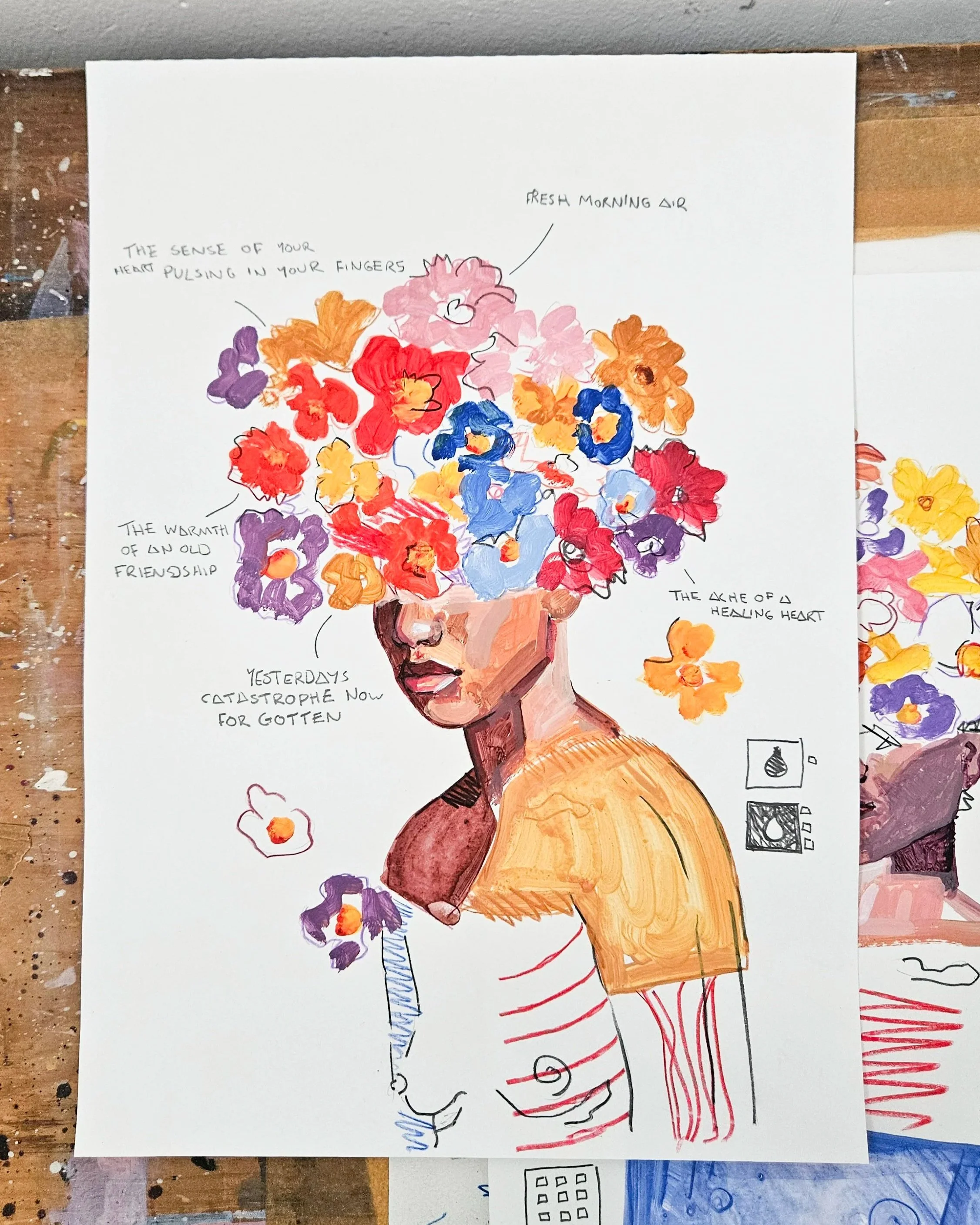
Imperfection is vital to that. A thumbprint in ink. The slight asymmetry of a handmade vase. The hesitancy of a line that reveals the presence of a hand. These traces of humanity are what separate a piece of art from a mass-produced product sliding off a conveyor belt: smooth and flawless.
So, where does AI leave us?
Probably moving in several directions at once. AI will inevitably take commercial creative work from many artists, increasing financial pressure in a field already difficult to survive in. It will produce vast quantities of cheap, low-effort imagery, feeding mass consumerism and overcrowding an already saturated visual landscape.
But I also believe this moment will make something else more valuable:
the artist’s story, their process, their humanity.
People will look for work made by human hands. They will crave objects with a history, pieces that carry the marks of thought and time. Artists who can articulate their process, the journey with the work, will stand out even more.
Art is, at its core, the journey of learning how to be human. It is the lifelong attempt to understand ourselves and accept our own imperfections. And in a future where machines can produce anything instantly and flawlessly, the imperfect objects that reveal our humanity may become the most beautiful reminders of who we are.